
Operational Challenges for Dry-Type Transformers in Kazakhstan
Operating electrical equipment in Kazakhstan means dealing with some of the harshest environmental and operational realities in Central Asia. As an industrial dry type transformer manufacturer serving Kazakhstan, we engineer our equipment to withstand massive temperature swings, high seismic activity, and severe industrial pollution. Off-the-shelf units simply fail under these local conditions.
Sub-Zero Winter Extremes (-45°C) and Class C2/C3 Thermal Shock
Winter temperatures across northern and central regions like Karaganda and Pavlodar routinely plunge to -45°C. When a cold transformer is energized or rapidly loaded under deep freeze conditions, standard insulation cracks due to thermal shock.
-
- Class C2/C3 Compliance: We formulate our epoxy resin mix to meet stringent C2 and special C3 climatic classes, ensuring safe energization and operation down to -45°C without dielectric degradation.
- Low-Temperature Ductility: Core clamping structures, tie rods, and terminals use ductile steel alloys that resist brittle fracture during severe sub-zero thermal contraction.
Peak Summer Ambient Limits (+40°C) and Class F/H Insulation
Continental summers create the opposite extreme, with daytime ambient temperatures frequently surpassing +40°C in southern desert zones. High ambient heat severely restricts natural cooling capacity.
| Parameter | Standard Design | Our Kazakhstan Engineering Benchmark |
|---|---|---|
| Max Ambient Temperature | +30°C / +35°C | +40°C to +45°C continuous |
| Insulation Class | Class F (155°C) | Class H (180°C) materials used |
| Hotspot Temperature Rise Limit | 100K | 90K (Derated for extended service life) |
| Forced-Air Cooling Reserve | +20% to +30% | Up to +40% AF reserve capacity |
Heavy Dust Loading in Mining Zones: IP21 to IP54 Enclosures
Kazakhstan’s extensive open-pit mining, smelting, and extraction hubs in Aktobe, Zhezkazgan, and Balkhash generate massive airborne particulate loads. Conductive dust settling on dry-type coils creates tracking paths and triggers catastrophic flashovers.
-
- Standard Substation Rooms: Indoor units utilize reinforced IP21 or IP23 enclosures fitted with fine louvered screens to prevent ingress of airborne debris.
- Severe Mining Environments: For heavy dust and slurry loading, we supply IP54-rated enclosures equipped with closed-loop air-to-air heat exchangers, completely sealing the magnetic core and cast windings from contaminated ambient air.
Seismic Withstand Standards (Magnitude 8–9 Richter Scale)
Southern Kazakhstan, particularly the Almaty basin and surrounding territories, falls within active seismic zones rated 8 to 9 on the MSK-64 scale. Electrical substations must remain operational during and after ground acceleration events.
-
- Reinforced Mechanical Base: Heavy structural channels with cross-bracing eliminate frame resonance and structural shear.
- Core-and-Coil Anchoring: Windings are locked rigidly to the core using high-tensile fiberglass studs and elastic damping pads.
- Dynamic Stress Verification: Every seismic-certified unit is verified to withstand ground acceleration up to 0.4g–0.5g without coil displacement or mechanical binding.
Load Surges and Harmonic Mitigation in Metallurgy
The regional power grid handles substantial non-linear loads generated by electric arc furnaces, rolling mills, and heavy draglines. These operations trigger extreme current spikes, voltage dips, and intense harmonic pollution.
-
- Elevated K-Factor Ratings: We engineer our coils with standard K-factor designs from K-4 up to K-20, keeping eddy current losses within safe limits under distorted current waveforms.
- Thick-Section Copper Conductors: Windings feature oversized, electro-tin-plated electrolytic copper busbars and foils that absorb abrupt metallurgical load surges without localized thermal runaway.
Domestic Sourcing vs. Importing from an International Dry Type Transformer Manufacturer in Kazakhstan
Navigating the supply chain for electrical infrastructure in Kazakhstan requires balancing local availability with the technical rigor of international standards. While the domestic production landscape has grown, local facilities often face capacity constraints when handling specialized, high-efficiency, or non-standard technical specifications. When project requirements demand advanced thermal ratings or specific harmonic mitigation, local production often hits a bottleneck in both lead times and design flexibility.
For complex projects, we bridge this gap by offering premium power transformer solutions from our specialized manufacturing base, providing a high-performance alternative to regional limitations.
Logistics and Supply Chain Strategy
To overcome lead time issues, we leverage robust logistics corridors to ensure reliable delivery of custom-built units:
-
- Rail Logistics: Utilizing the Dostyk and Khorgos land ports, we streamline transit from our international production facilities directly into the heart of Kazakhstan’s industrial zones.
- Customization Capabilities: Unlike mass-market local producers, we specialize in bespoke builds that meet unique site requirements, such as enhanced short-circuit strength or specialized enclosure ratings.
- Overland Transit: We utilize established overland routes that minimize handling risks, ensuring that sensitive dry-type equipment arrives at your project site in pristine condition.
- Capacity Reliability: By working with a focused, high-output manufacturer like JL Transformer, clients avoid the production queues and resource shortages frequently seen in smaller, localized manufacturing setups.
Our approach ensures that your project timeline is protected by predictable manufacturing schedules and proven logistics chains, preventing the downtime often associated with waiting for domestic production slots.
Mandatory Technical Standards and EAC TR CU Certifications
Deploying electrical assets in Kazakhstan requires clear compliance pathways across Eurasian Economic Union (EAEU) mandates and national utility codes. As an experienced dry type transformer manufacturer, we engineer every unit to eliminate commissioning delays, ensuring complete alignment with regional grid operators and statutory inspection bodies.
Regulatory Compliance and Standard Harmonization
Our engineering team bridges the gap between global manufacturing and local technical frameworks. Every cast resin dry type transformer built for Kazakhstan undergoes verification to satisfy both IEC baselines and local GOST requirements:
-
- TR CU 004/2011 & TR CU 020/2011: Full certification for low/medium-voltage equipment safety and electromagnetic compatibility (EMC), guaranteeing zero radio interference with sensitive control networks.
- Harmonized IEC 60076-11 and GOST Standards: Dual-rated baseline designs reconcile IEC insulation limits with GOST-K and GOST-R mechanical overload tolerances, ensuring smooth KEGOC grid compliance.
- Class F1 Fire Behavior: Self-extinguishing epoxy formulations ensure zero halogen emissions and minimal smoke propagation, making our units mandatory for indoor commercial substations, hospitals, and underground mining pits.
- Class E2/E3 Environmental Ratings: Heavy atmospheric resilience designed to prevent tracking and dielectric breakdown during rapid freeze-thaw cycles and severe condensation events.
| Standard / Parameter | EAEU & GOST Requirement | Our Engineering Execution |
|---|---|---|
| Safety Certification | TR CU 004/2011, TR CU 020/2011 | Factory-certified EAC Declaration & Certificate of Conformity |
| Fire Safety Class | GOST R 54827 / IEC 60076-11 (F1) | Flame-retardant epoxy cast resin; self-extinguishing within seconds |
| Environmental Class | E2 (frequent condensation) / E3 (extreme) | Vacuum-degassed winding encapsulation, moisture-proof barrier |
| Climatic Class | C2 / C3 (transport/storage down to -45°C) | Cryogenic-grade resin to prevent resin crack propagation |
| Dielectric Testing | Routine lightning impulse & AC withstand | 100% factory routine tests with partial discharge guaranteed < 10 pC |
Calculating Total Cost of Ownership (TCO)
Procuring equipment for an industrial substation in Kazakhstan demands evaluating long-term operational expense alongside capital expenditure. Electricity tariffs across industrial hubs make no-load (core) and load (winding) loss minimization critical.
We utilize high-grade, grain-oriented silicon steel (CRGO) and laser-scribed core laminations to deliver a low-loss distribution transformer profile that drastically lowers lifetime utility penalties:
$TCO = C_{purchase} + (A × P_0) + (B × P_k)$
-
- C_{purchase}: Capital outlay and transit to site.
- $P_0$ (No-Load Losses): Continuous core losses evaluated using client capitalization rate ($A$).
- $P_k$ (Load Losses): Coil resistance losses evaluated at nominal operating load ($B$).
By reducing stray losses and optimizing coil geometry in line with our dry type power transformer technical specifications, we ensure that facilities operating continuous continuous mining and metallurgical loads recover unit price differentials within the first three years of operation.
Key Industrial Applications Across Kazakhstan
Every region in Kazakhstan throws different challenges at electrical infrastructure. Between heavy industrial loads, dense urban developments, and remote generation sites, selecting the right equipment depends entirely on where and how it operates. As a specialized dry type transformer manufacturer Kazakhstan buyers rely on for harsh environments, we build our units around these site-specific conditions. Understanding transformers types, differences, and usage scenarios is critical to matching the right design to each facility.
Mining and Metallurgy: Vibration Resistance and High Overload Margins
Crushers, ball mills, and electric arc furnaces subject power distribution networks to severe mechanical shock and continuous harmonic currents. Standard units fail early under these dynamics. Our cast resin transformers for mining and metallurgical operations feature:
-
- Reinforced core clamping structures: Mitigates the constant mechanical vibration caused by heavy crushing equipment.
- High thermal overload reserves: Designed to handle severe cyclic spikes without degrading insulation integrity.
- Encapsulated epoxy windings: Shields the active parts completely from abrasive coal, iron ore, and copper dust prevalent in sites across Karaganda and Pavlodar.
Oil and Gas Downstream Facilities: Explosion-Safe Indoor Distribution
Refineries and petrochemical plants around Atyrau and Aktau cannot risk fluid leaks, vapor ignition, or fire propagation inside substations. We build units that remove these hazards entirely:
-
- Zero flammable liquids: Eliminates the fire, explosion, and containment risks inherent to liquid-filled units.
- Class F1 fire behavior rating: The materials self-extinguish immediately when external flames subside, releasing zero toxic gases.
- Compact footprints: Facilitates secure installation directly inside pressurized control rooms and localized distribution centers without massive blast-wall separations.
| Sector | Primary Environmental Challenge | Required Transformer Feature |
|---|---|---|
| Mining & Metallurgy | High vibration, conductive dust, cyclic load peaks | Reinforced core frames, Class H insulation, IP54 rated enclosures |
| Oil & Gas Downstream | Hazardous indoor zones, corrosive atmospheres | F1 fire self-extinguishing resin, C4/C5 protective enclosure coating |
| Commercial & Data Centers | Space constraints, acoustic noise limits | Low-loss grain-oriented steel cores, acoustic dampening (<55 dB) |
| Renewable Energy | Remote desert/steppe siting, wide temperature swings | UV-resistant finishes, Class C2 thermal shock certification (-40°C) |
Urban High-Rises, Shopping Centers, and Data Centers in Almaty and Astana
Dense urban centers demand compact, completely silent, and maintenance-free electrical substations. Municipal codes in Almaty and Astana enforce strict safety policies for indoor commercial installations:
-
- Low noise generation: Precision-stepped, step-lap core joints bring operating acoustic levels down below standard city thresholds.
- Maximum safety for occupied spaces: Safe to position directly in basements, intermediate mechanical floors, or adjacent to occupied tenant zones.
- High power density: When powering large server facilities or commercial towers, high-capacity installations like a 2000 kVA transformer high capacity reliable power solution deliver substantial throughput within tight indoor square footage.
Renewable Energy: Auxiliary Step-Down Units for Solar and Wind Parks
Kazakhstan’s massive solar fields in the south and wind projects across the central steppe demand auxiliary transformers that endure raw, unprotected outdoor extremes:
-
- Thermal shock endurance: Seamlessly withstands rapid temperature shifts from baking daytime desert heat to sub-zero night freezes.
- Grid interface stability: Provides reliable low-voltage auxiliary power for inverters, tracker systems, and pitch control systems under fluctuating power quality.
- Minimal field maintenance: Sealed cast designs do not require oil level checks, dielectric sampling, or leak inspections, keeping operating expenses low in remote locations.
Cast Resin vs. VPI Transformers: Which Fits Kazakhstan Facilities?
When selecting equipment with an experienced dry type transformer manufacturer, Kazakhstan industrial teams typically weigh two main technologies: Cast Resin Dry Type (CRT) and Vacuum Pressure Impregnated (VPI). While both eliminate fire hazards associated with oil units, their performance diverges significantly under Central Asian environmental conditions.
| Performance Metric | Cast Resin Dry Type (CRT) | Vacuum Pressure Impregnated (VPI) |
|---|---|---|
| Dielectric Insulation | High (Epoxy vacuum encapsulated) | Moderate (Varnish dipped/baked) |
| Moisture & Condensation Runoff | Impervious (Zero absorption) | Vulnerable to ambient humidity |
| Short-Circuit Shear Strength | Superior (Solid monolithic mass) | Moderate (Relies on banding tape) |
| Harsh Mining Dust Resistance | Total coil isolation | Accumulates in open air ducts |
| Routine Maintenance Need | Visual inspection & quick blowdown | Deep vacuuming & re-varnishing |
Dielectric Strength and Moisture Withstand Comparison
Kazakhstan experiences intense temperature swings between heated indoor transformer substations and winter freezes. These swings generate severe condensation during shutdown cycles.
-
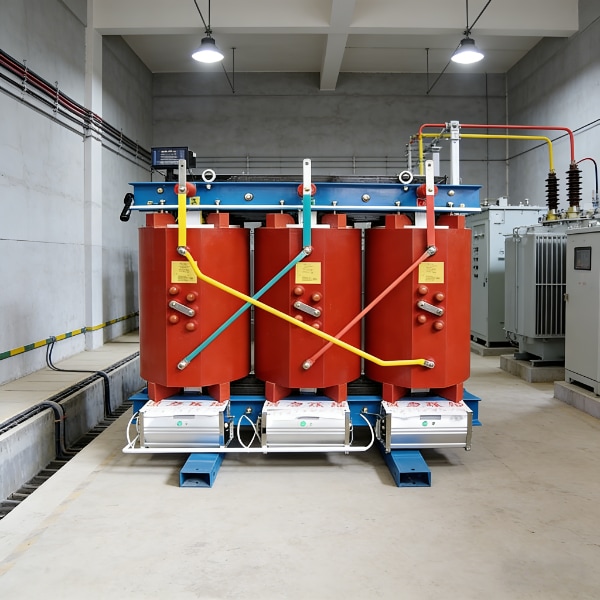
- Cast Resin Dry Type Transformers: The high-voltage windings are hermetically cast in pure epoxy resin under a continuous vacuum. Moisture cannot penetrate the core structure, preventing partial discharge spikes even during unheated winter restarts.
- Vacuum Pressure Impregnated (VPI) Units: VPI coils rely on polyester or silicone varnish coatings over winding conductors. Over time, moisture penetrates hairline gaps in the varnish, dropping insulation resistance and risking phase-to-phase breakdown during cold start-ups.
Mechanical Strength During Short-Circuit Faults
Heavy industrial facilities—such as metallurgical smelting plants in Karaganda or pumping stations across the western oil corridor—face frequent network load fluctuations.
Cast resin coils form a solid, rigid structure. This rigid barrier provides unmatched mechanical resistance against the radial and axial electromagnetic forces that occur during dead short-circuits. In contrast, VPI coils can experience mechanical coil displacement over repeated fault cycles as the varnish layer degrades, increasing turn-to-turn fault risks.
Dust Protection and Maintenance Needs in Industrial Zones
Fine, conductive dust is a constant operational hazard near coal extraction sites, mineral processing plants, and arid southern plains.
-
- VPI limitations: Open winding cooling ducts trap airborne dust, slag particulates, and carbon fibers. This buildup requires frequent shutdowns for solvent washing and vacuuming to prevent surface flashovers.
- Cast resin reliability: Smooth epoxy surfaces prevent particulate adherence. Routine upkeep requires nothing more than wiping down the outer surfaces or performing a brief dry-nitrogen blowdown during standard plant turnarounds.
Why Cast Resin Serves as the Primary Local Benchmark
For local EPC contractors and plant operators, cast resin represents the clear standard for reliable power distribution. Drawing on our direct manufacturing work supplying robust power transformer solutions for heavy industrial applications, we consistently recommend cast resin for installations across Kazakhstan.
The monolithic epoxy construction provides Class E2/E3 environmental protection and Class C2/C3 cold climate resistance down to -45°C. By fully insulating vital electrical pathways against moisture, conductive mining dust, and physical stress, cast resin delivers zero-maintenance uptime that open-wound VPI alternatives cannot match in harsh environments.
How to Vet a Dry Type Transformer Manufacturer for Kazakhstan Projects
Selecting the right partner requires auditing specific manufacturing tolerances, protective finishes, and delivery capabilities. When evaluating an international or regional dry type transformer manufacturer for Kazakhstan installations, we advise technical teams to benchmark prospective vendors against four core engineering pillars.
In-House Testing and Partial Discharge Verification
Routine and type testing must be conducted under strict quality protocols before equipment leaves the factory floor:
-
- Partial Discharge (<10 pC): Regional winter temperature swings demand flawless insulation. We ensure all coils achieve partial discharge levels under 10 picocoulombs (pC) at 1.3 times rated voltage, preventing micro-fractures during freeze-thaw cycles.
- Full Lightning Impulse Testing: Units intended for industrial networks and heavy substations must demonstrate verified impulse withstand ratings matching IEC 60076-11 and regional GOST criteria.
- Routine Test Reporting: Every SCB-11 cast resin dry-type power transformer must include detailed factory acceptance test (FAT) documentation, covering winding resistance, impedance voltage, short-circuit withstand, and no-load losses.
Custom Enclosure Finishes and Cable Entry Adaptability
Standard off-the-shelf enclosures fail quickly in harsh industrial atmospheres. We configure protective housings to the exact site environment:
| Feature | Standard Configuration | Heavy Industrial / Mining Specification |
|---|---|---|
| Corrosion Protection | ISO 12944 Class C2/C3 powder coat | High-durability Class C4 or C5-M anti-corrosion coating |
| Ingress Rating | IP20 to IP23 for indoor switchrooms | IP31 to IP54 with filtered louvers and forced-air fans |
| Cable Interfaces | Standard bottom-entry knockout plates | Custom bus duct connections or top/bottom split gland plates |
| Grounding Provision | Dual copper terminal pads | Heavy-duty copper earth bus running full enclosure length |
Border Logistics and Transit Protection
Transporting heavy electrical equipment across Central Asia requires careful logistics planning:
-
- Border Point Preparedness: Direct overland shipping via the Khorgos or Dostyk rail and road arteries requires pre-cleared customs manifests and accurate EAC TR CU conformity documentation to eliminate border bottlenecks.
- Transit Impact Mitigation: Rail shunting and rough road corridors introduce mechanical vibration risks. We secure all transformer cores and frames with specialized transit bracing and 3D acceleration/shock sensors.
- Transit Insurance Coverage: End-to-end cargo insurance tailored for overland freight guarantees coverage up to final site offloading.
Commissioning Guidance and Spare Parts Availability
A reliable transformer manufacturer must stay engaged long after site delivery. We provide clear technical support spanning:
-
- Engineering Supervision: Step-by-step pre-commissioning checklists, insulation resistance verification procedures, and remote engineering sign-offs.
- Rapid-Response Spare Components: Availability of auxiliary systems, including replacement PT100 temperature sensors, digital temperature controllers, and cross-flow cooling blower assemblies dispatched immediately to keep operations online.
Technical Advantages of Sourcing from JL Transformer
When operating in Central Asia’s unforgiving grid environments, standard off-the-shelf units rarely hold up. As an experienced dry type transformer manufacturer for Kazakhstan and regional cross-border infrastructure, our team builds medium-voltage equipment engineered directly around local operational realities. From Karaganda’s sub-zero industrial plants to oil facilities in Atyrau, our units are engineered to run reliably without downtime.
As a specialized custom transformer manufacturer for reliable power solutions, we eliminate the middleman, engineering directly to client-specified loss levels, dimensional footprints, and harsh climate requirements.
Engineering Up to 35 kV and 25 MVA for Extreme Climates
We design and manufacture heavy-duty cast resin systems that handle extreme thermal swings from -45°C winter freezes up to +40°C summer heatwaves.
-
- Voltage & Capacity Range: Custom ratings up to 35 kV and capacities up to 25 MVA, fully tailored to step-down substation needs.
- Thermal Shock Durability: Certified Class C2/C3 thermal endurance guarantees no resin cracking during sudden cold starts in unheated substations.
- Low-Loss Efficiency: Core designs using high-grade, cold-rolled grain-oriented (CRGO) silicon steel dramatically reduce no-load losses, lowering total cost of ownership (TCO).
| Technical Parameter | Standard Specification | Severe-Duty Kazakhstan Spec |
|---|---|---|
| Rated Voltage | Up to 10 kV / 20 kV | Up to 35 kV |
| Power Capacity | 100 kVA to 3,150 kVA | Up to 25 MVA |
| Thermal Shock Class | Class C1 (0°C) | Class C2 / C3 (-25°C to -45°C) |
| Insulation System | Class F (155°C) | Class H (180°C) Nomex / Epoxy |
| Partial Discharge | < 10 pC | < 5 pC at 1.3 Um |
| Enclosure Rating | IP00 / IP20 | IP23 to IP54 (Dust & Snow Proof) |
Automated Vacuum Epoxy Casting
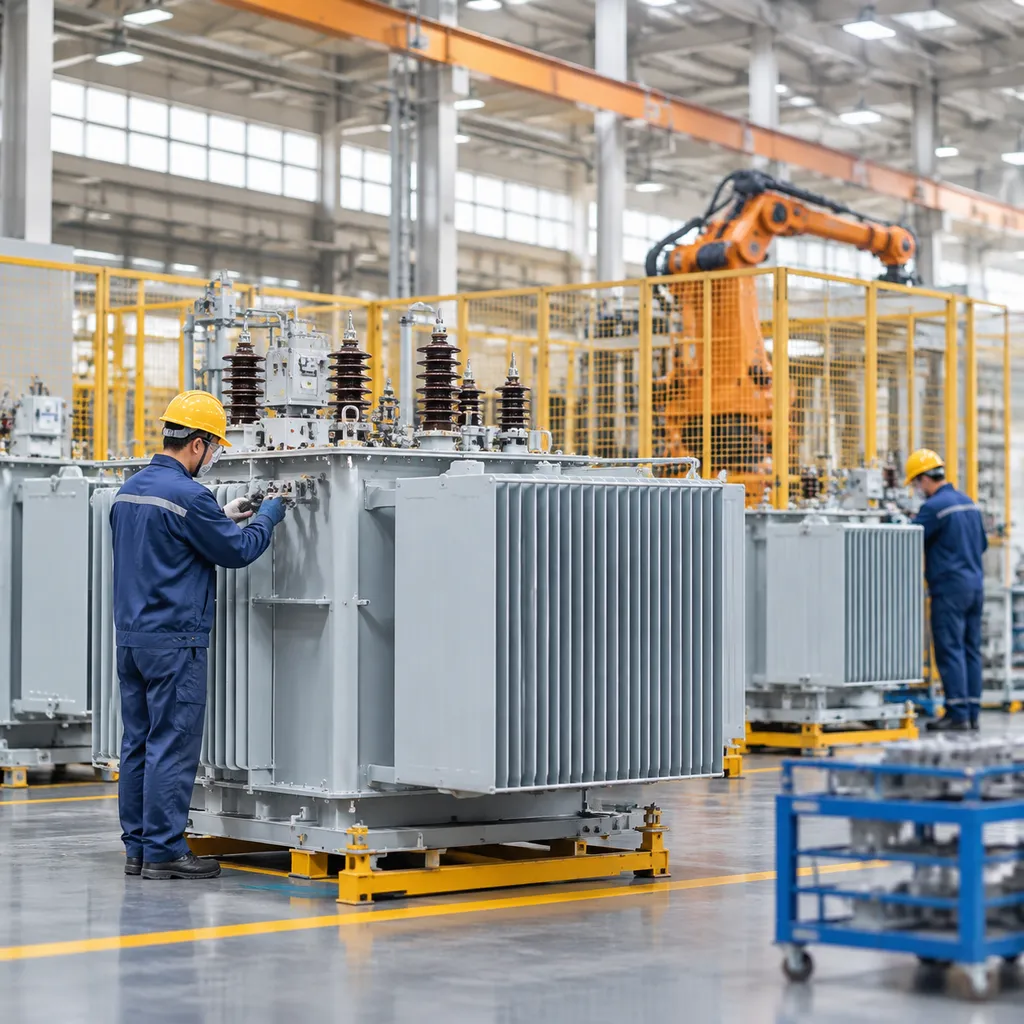
Our production floor relies on automated thin-insulation vacuum casting equipment. By degasifying and pouring premium epoxy under high vacuum, we prevent micro-voids inside the windings.
-
- Minimal Partial Discharge: Guaranteed partial discharge levels remain below 5 to 10 pC, significantly outperforming regional standards.
- Moisture & Chemical Immunity: Windings are fully impervious to heavy dust, corrosive salts, and condensation cycles common in mining and processing hubs.
- Self-Extinguishing Safety: Fully compliant with Class F1 fire behavior, eliminating toxic emissions and explosion hazards indoors.
Built-in PT100 Monitoring and 40% Overload Capacity
Industrial plants cannot afford downtime during sudden production spikes. We equip our cast resin dry type transformers with integrated thermal safeguards and smart forced-air cooling (AF):
-
- Precision Thermal Tracking: Factory-installed PT100 platinum thermal sensors inside each phase winding connect directly to digital temperature controllers for remote SCADA integration.
- Forced-Air Cooling Reserves: Activating the low-noise cross-flow cooling fans instantly increases output rating by up to 40% without compromising coil insulation life.
- Harmonic Resilience: Engineered electromagnetic structures easily withstand non-linear loads generated by variable-frequency drives (VFDs) and metallurgical furnaces.
Direct Overland Logistics to Kazakh Work Sites
Lead times make or break project schedules. We bypass congested sea-freight routes by managing direct overland transport corridors. Shipping directly via Khorgos and Dostyk rail and heavy-haul road lines allows our units to arrive on site in Almaty, Astana, or Shymkent faster, complete with international transit insurance, secure crating, and pre-commissioning field documentation ready for handoff.
Frequently Asked Questions About Dry-Type Transformers in Kazakhstan
For project managers and engineers navigating the procurement of a dry type transformer manufacturer in Kazakhstan, clarity on technical and regulatory standards is essential for operational success.
How do extreme winter temperatures affect dry type transformer selection?
Kazakhstan’s winter extremes, often dipping to -45°C, necessitate specific design considerations. Standard units may face cracking in epoxy resin or insulation failure due to thermal contraction. We prioritize Class C2/C3 thermal shock compliance, ensuring the casting material maintains structural integrity and dielectric strength despite rapid temperature fluctuations during start-up or sudden load changes.
What certifications are legally required to commission a dry type unit in Kazakhstan?
All electrical distribution equipment must comply with EAC TR CU 004/2011 (Low Voltage Equipment) and TR CU 020/2011 (Electromagnetic Compatibility). Furthermore, installations often require adherence to local GOST-K standards. Ensuring your SCB18 dry-type transformer carries these mandatory certifications is critical to avoiding delays during site inspection and grid connection by local utility authorities.
Can imported dry type transformers seamlessly replace legacy GOST oil transformers?
Yes, provided the footprint and connection profiles are engineered accordingly. When retrofitting, we focus on matching the existing busbar arrangements and mounting dimensions of legacy oil-immersed units. A high-efficiency dry type transformer offers a smaller fire-risk profile and eliminates oil leakage risks, making it a superior choice for indoor substations where space is at a premium and safety regulations are stringent.
What lead times should buyers expect when importing custom dry type transformers?
Lead times are heavily influenced by the customization level and logistics corridor. While standard units might ship within 4–6 weeks, custom-engineered transformers designed for high-seismic zones or specific metallurgical loads typically require 8–12 weeks for production and testing. We utilize high-speed rail logistics via the Dostyk and Khorgos corridors, which significantly cuts transit time compared to traditional sea-freight routes, ensuring your equipment arrives ready for installation on schedule.