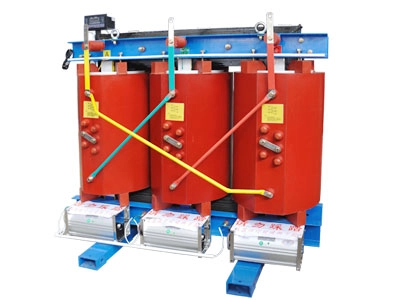
- Transformer manufacturers in China

The SC(B)11, SC(B)12, SC(B)13 and SCB18 series are three-phase cast-resin dry-type transformers. Their individual catalogue schedules provide different no-load and load-loss values. Select the rated capacity and voltage configuration, then confirm the insulation system, cooling arrangement and enclosure for the installation.
The schedules show high-voltage options of 6, 6.3 and 10 kV with a 0.4 kV low-voltage rating. SC(B)11, SC(B)12 and SC(B)13 list capacities from 30 to 2,500 kVA; the SCB18 schedule covers 30 to 2,000 kVA.
| Series | No-load Loss (W) | Load Loss (W) | Reference Conditions |
|---|---|---|---|
| SC(B)11 | 1770 | 8130 | Confirm the load-loss reference temperature in the technical schedule |
| SC(B)12 | 1416 | 8130 | Confirm the load-loss reference temperature in the technical schedule |
| SC(B)13 | 1239 | 7317 | Confirm the load-loss reference temperature in the technical schedule |
| SCB18 | 1020 | 6,885 / 7,315 / 7,885 | B (100°C) / F (120°C) / H (145°C) columns, respectively |
These are the listed 1,000 kVA catalogue entries, not a universal percentage reduction or efficiency certification. Load-loss comparisons require matching voltage, connection and reference temperature. Refer to each product page for the other listed capacities.
The SC(B)11 brochure specifies Class F insulation and an IP00 open design, with IP20 or IP23 enclosures available on request. Do not apply this configuration automatically to the other series. The SCB18 loss table separates B, F and H reference-temperature columns; confirm the insulation system and applicable column for the selected unit.
Confirm the enclosure, installation, ventilation and fire-safety provisions for the site. Cast-resin dry-type construction does not by itself establish a hazardous-area explosion-protection rating.
The SC(B)11 brochure describes applications including buildings, hospitals, airports and tunnels. Suitability depends on the selected design and site requirements.
The SC(B)13 brochure illustrates power networks, factories, urban infrastructure, ports and shopping centres. Confirm the electrical and environmental conditions.
The SCB18 brochure describes operation near load centres. Confirm access protection, ventilation, ambient conditions and the applicable installation requirements.
The SCB model descriptions identify epoxy-resin cast dry-type construction. The SC(B)12 brochure describes resin mixing and vacuum degassing. The SCB18 brochure describes temperature monitoring and protection options, together with forced-air cooling for additional loading. Confirm the actual components, permitted loading and duration for the selected design; do not assume a fixed capacity increase.
Request the model-specific technical schedule, insulation and enclosure details, loss values, impedance, dimensions, weight and sound-level data. Agree the required inspection and test records before ordering. Project standards and any certification requirements must be verified for the specific product and destination.
Their catalogue loss schedules differ. For example, the listed 1,000 kVA no-load losses are 1,770 W for SC(B)11, 1,416 W for SC(B)12, 1,239 W for SC(B)13 and 1,020 W for SCB18. Confirm the complete technical configuration and conditions before selecting a series.
Do not assume a fixed reduction. In the supplied schedules, both 1,000 kVA entries list a load loss of 8,130 W. Use rating-specific data and matching reference conditions.
Use the applicable B (100°C), F (120°C) or H (145°C) reference-temperature column. Do not choose one column solely because it has the lowest value.
No common configuration is established by the series name alone. The SC(B)11 brochure specifies Class F and an IP00 open design, with IP20 or IP23 options. Confirm the selected configuration for every series.
The SCB18 brochure describes additional loading with forced-air cooling but does not state a universal percentage. Confirm permitted loading, duration and operating conditions in the technical schedule.
Request documentation for the required model, configuration and destination. A brochure series name or logo does not define the full scope of a product approval.
Send your required capacity, primary and secondary voltages, frequency, connection, installation conditions, quantity and project location. Include the technical and documentation requirements for the project.
Email [email protected].