Energy Modernization and Grid Demands in Uzbekistan
Uzbekistan is undergoing one of the most aggressive power sector overhauls in Central Asia. Massive industrial expansion across key hubs—including the Tashkent Industrial Zone, Samarkand manufacturing parks, and the Navoi Free Economic Zone (FEZ)—has placed unprecedented loads on regional distribution networks. To support this growth, project developers and utilities are rapidly shifting away from depreciated Soviet-era systems toward modern, high-efficiency equipment.
As a dedicated oil immersed transformer manufacturer for Uzbekistan and Central Asian energy initiatives, we engineer robust medium-voltage solutions built specifically to handle these shifting grid dynamics.
Critical Power Priorities Across Key Sectors
-
- Industrial & Free Economic Zones: Facilities in Navoi and Tashkent demand continuous, heavy-duty 10kV to 0.4kV step-down distribution to prevent costly production line trips.
- Mining & Heavy Processing: Deep metallurgical extraction and chemical plants require transformers engineered for severe harmonic distortions, unbalanced loading, and high duty cycles.
- Grid Decarbonization & Modernization: Replacing outdated legacy distribution units with low-loss, high-efficiency transformer architectures drastically cuts utility distribution losses and lowers operating expenditures across regional municipal networks.
- Infrastructure Resilience: Upgraded medium-voltage networks must maintain voltage stability despite long feeder runs and fluctuating rural utility feeds.
Central Asian Climate Challenges for Oil-Immersed Transformers
Deploying distribution hardware across Central Asia means designing around punishing thermal swings, fine sand, and unstable regional feed lines. As an oil immersed transformer manufacturer Uzbekistan contractors rely on, we engineer our equipment to overcome severe environmental and operational stress points without unexpected derating.
ONAN Cooling Performance in Extreme +45°C Heat
Standard international designs assume ambient temperatures peak at +40°C with a +30°C daily average. In desert regions like Navoi and Bukhara, summer temperatures easily push past +45°C in direct sunlight, accelerating insulation degradation.
-
- Lower Temperature Rise Limits: We configure our winding and top-oil temperature rise thresholds 5°C to 10°C below standard thresholds to prevent thermal runaway.
- Expanded Corrugated Radiators: Our ONAN cooling system uses widened oil ducts and maximized fin surface areas to ensure natural convective oil flow maintains nominal kVA output even during peak summer loads.
- High-Flashpoint Insulating Oil: Mineral oil options undergo strict dehydration and degassing to maintain thermal conductivity and dielectric breakdown strength under prolonged heat cycles.
Hermetically Sealed vs. Conservator Tanks in Arid Environments
Fine dust and sandstorms quickly contaminate traditional open-breathing conservator systems. When choosing equipment, understanding power transformers and distribution transformers helps match the right tank style to the site conditions:
-
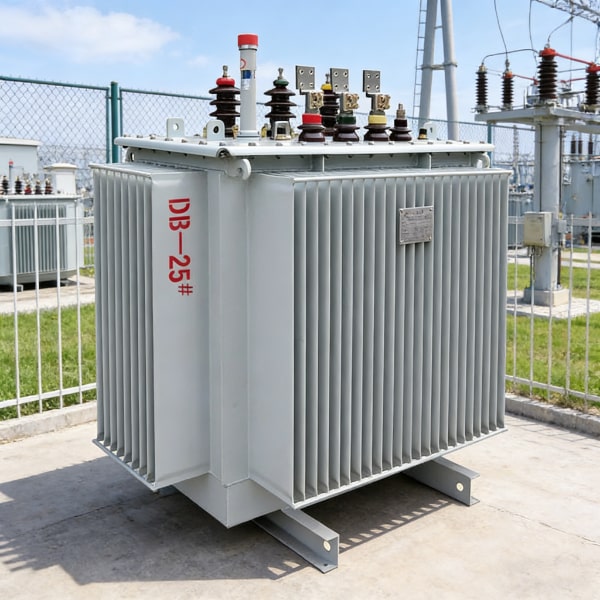
- Hermetically Sealed Oil Transformers: Completely sealed tanks with flexible corrugated fins eliminate ambient air exchange. This isolates the oil from oxygen and airborne particulate matter, preventing sludge buildup and doing away with routine desiccant maintenance.
- Conservator Tank Designs: For higher-capacity units, we supply conservator tanks equipped with heavy-duty air breathers, nitrogen bladders, and double-float Buchholz relays to prevent air-oil contact while managing large volumetric oil expansion.
Structural Engineering for Grid Fluctuations and Harmonics
Regional medium-voltage lines frequently suffer from voltage spikes, frequency drift, and severe harmonic loads generated by heavy mining equipment and industrial drives.
-
- Core Saturation Prevention: We engineer magnetic circuits using high-permeability silicon steel with conservative flux density margins (typically 1.6 to 1.65 Tesla). This prevents core overheating during continuous grid overvoltage conditions.
- Reinforced Mechanical Clamping: Winding assemblies are braced with high-density pressboard spacers and rigid tie-plates to prevent coil deformation caused by sudden external short-circuits.
- Harmonic-Resistant Windings: Optimized insulation structures and electrostatic shielding reduce eddy-current hot spots caused by non-linear industrial loads.
Technical Compliance: Harmonizing IEC 60076 and GOST Standards
Operating on the regional grid in Uzbekistan requires navigating two distinct engineering frameworks: legacy GOST requirements and modern international benchmarks. As an experienced oil immersed transformer manufacturer Uzbekistan contractors rely on, we eliminate this friction by engineering distribution equipment that fully bridges both standards.
Bridging Regional GOST Requirements and IEC Standards
Local utilities and industrial plants across Uzbekistan often mandate strict compliance with GOST dimensional clearances, terminal markings, and oil insulation criteria, while international EPC developers design around IEC 60076 parameters. We align both systems during factory design:
-
- Dual-Standard Documentation: Every unit ships with factory test reports and technical passports certified under both IEC 60076 and relevant GOST norms.
- Terminal Configurations: Bushing arrangements and cable boxes accommodate traditional regional cable terminations as well as modern enclosed touch-proof plug-in connectors.
- Vector Group Flexibility: We build standard Dyn11 configurations for stable neutral balance under unbalanced single-phase loads, as well as legacy Yyn0 arrangements where required by municipal utilities. For a deeper breakdown of how specific core-and-coil configurations fit different electrical layouts, review our guide on understanding transformers types differences and usage scenarios.
Standard Medium-Voltage Step-Down Ratings
Whether tying into older 6 kV municipal feeds, expanding within modern 10 kV industrial zones, or stepping down directly from 35 kV regional transmission spurs, our core designs match standard Central Asian grid inputs directly to 0.4 kV working voltages.
| Primary Voltage (HV) | Secondary Voltage (LV) | Typical Power Ratings | Vector Groups | Standard Compliance |
|---|---|---|---|---|
| 6 kV | 0.4 kV (400V) | 160 kVA – 1000 kVA | Dyn11 / Yyn0 | IEC 60076 / GOST |
| 10 kV | 0.4 kV (400V) | 250 kVA – 2500 kVA | Dyn11 / Yyn0 | IEC 60076 / GOST |
| 35 kV | 0.4 kV (400V) | 630 kVA – 2500 kVA+ | Dyn11 / Yyn0 | IEC 60076 / GOST |
Balancing CapEx and OpEx: Evaluating No-Load and Load Losses
Evaluating purchase price alone often leads to inflated operating costs over a 20- to 30-year asset life. Our team structures core and winding geometry to optimize total cost of ownership by strictly controlling loss parameters:
-
- No-Load Losses (P0): We use precision-stacked, high-permeability cold-rolled grain-oriented (CRGO) silicon steel cores with step-lap mitered joints. This minimizes continuous baseline core excitation losses, keeping idling costs low 24/7.
- Load Losses (Pk): We wind our coils using high-conductivity electrolytic copper conductors with calibrated current densities. This suppresses I²R resistive heating losses during peak production shifts.
- Short-Circuit Impedance (Uk%): Engineered to standard 4.0% to 4.5% ratings for units under 630 kVA and 6.0% for 1000 kVA to 2500 kVA ratings, ensuring a balance between fault-current limitation and secondary voltage stability.
Oil-Immersed Transformer Sizing and Product Spectrum
As a dedicated oil immersed transformer manufacturer Uzbekistan contractors rely on, we engineer our equipment across three targeted capacity tiers. Whether you are electrifying rural farming regions, running automated production lines, or powering heavy extractive operations, our oil-immersed distribution transformer lineup covers every load profile with optimized losses and durable insulation.
Sizing Tiers at a Glance
-
- Compact Utility Units (30 kVA to 250 kVA): Designed for municipal networks, rural electrification, commercial hubs, and agricultural pumping stations. These compact footprint units reduce installation footprint on poles or pre-fabricated pad mounts while maintaining low no-load losses during off-peak hours.
- Standard Industrial Workhorses (315 kVA to 800 kVA): Built for continuous duty in textile mills, food processing plants, and light assembly facilities. A 630 kVA oil immersed transformer in this range easily handles continuous thermal stress and variable motor-starting currents without insulation degradation.
- High-Capacity Substation Units (1000 kVA to 2500 kVA+): Engineered for severe operating conditions in metallurgy, mining sites, and primary distribution substations. Sourcing directly from an established transformer 1000 kVA manufacturer ensures your plant gets heavy-duty copper windings and tank reinforcement that withstand high short-circuit stresses and harmonic distortion.
| Capacity Range | Typical Application | Common Voltage Ratios | Standard Cooling | Tap Changer Type |
|---|---|---|---|---|
| 30 kVA – 250 kVA | Rural grids, commercial, pumping | 6/0.4 kV, 10/0.4 kV | ONAN | OCTC (±2×2.5%) |
| 315 kVA – 800 kVA | Manufacturing plants, warehouses | 10/0.4 kV, 35/0.4 kV | ONAN | OCTC / OLTC |
| 1000 kVA – 2500 kVA+ | Heavy industry, mining substations | 10/0.4 kV, 35/6 kV, 35/10 kV | ONAN / ONAF | OLTC / OCTC |
Tap Changer Selection: OCTC vs. OLTC
Grid stability varies widely across industrial corridors and remote job sites, making voltage regulation a critical sizing decision:
-
- Off-Circuit Tap Changer (OCTC): Standard configuration (typically ±5% or ±2×2.5%). Best suited for installations with relatively predictable primary network voltages where ratio changes are infrequent and scheduled during maintenance shutdowns.
- On-Load Tap Changer (OLTC): Essential for continuous production environments, metallurgy operations, and sites tied to unstable rural utility lines. An OLTC automatically corrects for incoming line drops under full load, preventing process halts, motor tripping, and equipment failure.
Manufacturing Architecture: Core, Coils, and Tank Engineering
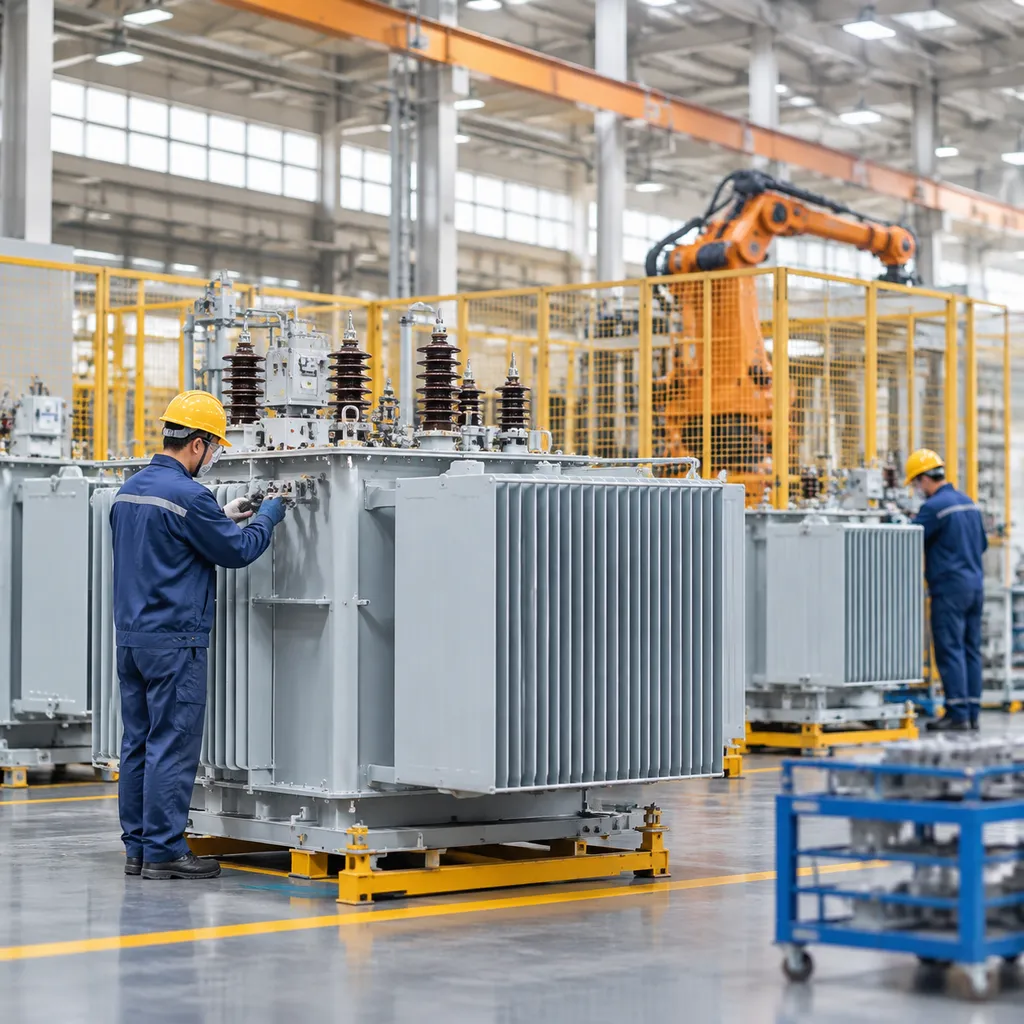
As a dedicated oil immersed transformer manufacturer Uzbekistan contractors trust for tough operating conditions, we engineer every mechanical and electrical subsystem in-house. Reliable field performance starts on the factory floor, where our production line balances high-grade core metallurgy, robust winding geometry, and hermetic tank integrity.
High-Efficiency Silicon Steel Core
-
- CRGO Laminations: We use high-permeability, cold-rolled grain-oriented (CRGO) silicon steel cut with multi-step step-lap miter joints to minimize eddy currents and no-load losses.
- Structural Rigidity: Heavy-gauge clamping frames and epoxy-coated bonding secure the core legs against transit vibration and operational mechanical stress.
Copper Winding Power Transformer Construction
-
- Electrolytic Grade Copper: Windings utilize high-conductivity electrolytic copper insulated with thermally upgraded kraft paper to handle continuous loads and thermal cycling.
- Short-Circuit Resilience: Coil structures feature radial and axial spacers, pre-compressed under hydraulic pressure to withstand abrupt external short circuits across medium-voltage networks.
Corrugated Tank Fabrication and Vacuum Oil Filling
-
- Automated Corrugated Walls: Tank panels are formed on automated folding lines, providing expandable fin walls that absorb thermal oil expansion without requiring an external conservator.
- Vacuum Drying and Degassing: Core-coil assemblies undergo thorough hot-air circulation and deep vacuum cycles before automated oil injection, eliminating trapped air bubbles and moisture.
- Industrial Corrosion Protection: Tanks receive shot blasting, zinc-rich primer, and multi-layer polyurethane topcoats engineered to resist dry sand abrasion and extreme outdoor exposure. Similar structural safeguards are built into our oil-immersed transformer manufacturer direct supply solutions across global utility projects.
Protection and Monitoring Instrumentation
| Component | Standard Function | Operational Benefit |
|---|---|---|
| Buchholz Relay | Detects internal gas accumulation and oil surge | Early alarm and trip signals for internal faults |
| Pressure Relief Valve | Spring-loaded rapid overpressure release | Prevents tank rupture during severe sudden overloads |
| Oil Level Gauge | Float-type visual indicator with low-level contacts | Real-time monitoring of dielectric fluid inventory |
| Dial Thermometer | Dual-contact top-oil temperature monitoring | Automatic tripping during extreme ambient heat waves |
Factory Acceptance Testing (FAT) and Quality Documentation
As a dedicated oil immersed transformer manufacturer for Uzbekistan, we make sure no unit leaves our production floor without strict, verifiable performance verification. Uzbek grid engineers and industrial EPC contractors need verified data before equipment ships across borders. Our testing lab executes complete test protocols to satisfy both local utility authorities and international investors.
Mandatory Routine Testing
Every single distribution and power unit undergoes standard routine checks under full supervision:
-
- Winding Resistance Measurement: Verifies balanced DC resistance across all tap positions and checks for cold solder joints or loose terminal contacts.
- Voltage Ratio & Vector Group Verification: Confirms precise turns ratios matching specified medium-to-low voltage step-down steps (such as 10/0.4 kV or 35/0.4 kV) and validates Dyn11 or Yyn0 phase displacement.
- Short-Circuit Impedance & Load Loss (Pk): Measures real-world copper losses at rated frequency to confirm compliance with contract tolerances.
- No-Load Loss (P0) & No-Load Current: Checks core magnetization performance and validates minimal idle power consumption using calibrated digital power analyzers.
- Insulation Integrity Checks: Includes separate-source AC withstand voltage tests and induced overvoltage testing to ensure the dielectric system stands up to grid disturbances.
Type and Special Testing Options
For turnkey substation packages and heavy industrial sites, our facility performs advanced type and special tests on demand:
-
- Full-Wave Lightning Impulse Test: Simulates high-voltage grid surges to verify core-and-coil insulation strength.
- Temperature Rise Test: Run at full load to prove our ONAN radiator cooling keeps top oil and winding hot spots well below design thresholds in +45°C ambient heat.
- Dielectric Oil Breakdown: Testing dielectric breakdown voltage (BDV) and moisture content (ppm) of the transformer mineral oil prior to tank sealing.
- Acoustic Noise Level Checks: Measuring decibel levels to comply with municipal noise rules in urban centers like Tashkent and Samarkand.
| Test Category | Standard Protocol | Target Metric |
|---|---|---|
| Routine | Turns Ratio & Polarity | Within ±0.5% of design spec |
| Routine | Insulation Resistance (Megger) | > 1000 MΩ at 2500V DC |
| Special | Lightning Impulse (1.2/50 μs) | Full BIL withstand per IEC 60076-3 |
| Special | Oil Dielectric Strength | BDV ≥ 50 kV / 2.5 mm gap |
Essential Uzbek Compliance & Customs Documentation
Clearing customs and passing utility commissioning in Uzbekistan demands flawless paperwork. Following the same quality assurance standards used in our international power transformer wholesale solutions, we provide a complete engineering data dossier with every delivery:
-
- Certified Factory Acceptance Test (FAT) Reports: Stamped inspection sheets containing raw readings, ambient test temperatures, and certified pass/fail parameters.
- Certificates of Origin & Conformity: Documentation aligned with Uzbek national standards (GOST/O’z DSt) and customs transit codes.
- Dimensional Drawings & Terminal Schematics: Clear 2D/3D layouts showing exact lifting lug positions, center of gravity, bushing spacing, and terminal connection details.
- Operation & Maintenance (O&M) Manuals: Detailed field instructions covering site inspection, oil sampling, bushing torque values, and tap-changer handling.
Safe Transit and Logistics to Uzbekistan
Long-distance transport across Central Asia puts heavy mechanical stress on electrical equipment. As an experienced oil immersed transformer manufacturer Uzbekistan projects rely on, we engineer our freight packaging to withstand cross-border rail and road transport over rough terrain, preventing core shifting and bushing damage before arrival on site.
Mechanical Bracing Against Transit Shock
To ensure internal assemblies remain perfectly aligned from our factory floor to your substation pad:
-
- Internal Core Anchoring: We bolt active parts directly to heavy-duty internal tank frame braces, stopping longitudinal and lateral movement during sudden rail braking or road vibrations.
- External Bushing Protection: High-voltage and low-voltage porcelain bushings are packed in reinforced wooden crates or shielded with custom steel cages to eliminate impact cracking.
- Impact Recorders: We mount 3-axis digital impact indicators on every medium- and high-capacity unit to monitor g-force levels at key border crossing checkpoints.
Transport Modes: Oil-Filled vs. Dry Nitrogen
Choosing between fully assembled oil delivery and nitrogen preservation depends on unit capacity, transport weight regulations, and on-site handling gear. Similar to our global logistics protocols used in factory-direct oil-immersed transformer supply, we match the shipping configuration strictly to site readiness.
| Transformer Rating | Transport State | Key Benefit | Site Requirement |
|---|---|---|---|
| 30 kVA to 1600 kVA | Fully Oil-Filled | Fast deployment; zero oil handling on site | Immediate positioning and pre-commission testing |
| 2000 kVA to 2500 kVA+ | Dry Nitrogen Sealed (0.02–0.03 MPa) | Lower gross shipping weight; protects core from ambient moisture | Vacuum filling equipment and oil dielectric testing on site |
Transit Routes and Lead Time Management
We route freight to major industrial hubs including Tashkent, Samarkand, and the Navoi Free Economic Zone using established rail corridors through Khorgos and Dostyk:
-
- Direct International Rail Freight: Containerized or open-wagon flatbed solutions with standard transit windows of 14 to 20 days from departure to Central Asian terminals.
- Border Clearance Coordination: We prepare full customs packages—including packing lists, HS codes, and factory test certificates—in advance to avoid border terminal delays.
- Consignment Tracking: Our logistics team provides daily location telemetry updates until the cargo clears local customs and transfers to your local site carrier.
Direct Manufacturer Sourcing vs. Third-Party Traders
Procuring directly from an established oil immersed transformer manufacturer for Uzbekistan projects eliminates middleman markups and gives EPC contractors full technical control. When managing tight project milestones in regions like Tashkent or Navoi, working straight with the plant floor guarantees exact compliance with your single-line diagrams, clearance limits, and local substation footprints.
Factory Direct Procurement vs. Intermediaries
| Feature / Criteria | Direct Manufacturer Procurement | Third-Party Trading Companies |
|---|---|---|
| Pricing & Margin | Factory-gate pricing with no tiered brokerage fees | 15% to 30% broker markups added |
| Engineering Support | Direct dialogue with design teams for vector groups and drawings | Relayed messages, delayed revisions, risk of miscommunication |
| Custom Schematics | Fast turnaround for custom tap-changer layouts and bushing orientations | Limited standard catalog options; slow modification approval |
| Quality Control & FAT | Witnessed factory testing (virtual or in-person) with full raw test logs | Third-party test summaries with limited traceability |
| Warranty & Spare Parts | OEM warranty with immediate dispatch of genuine gaskets, valves, and relays | Relies on third-party claims processing and extended lead times |
Direct Technical Alignment and Custom Engineering
Our engineering team works hand-in-hand with your design office from day one. Instead of waiting weeks for a broker to clarify basic electrical parameters, we directly review your load profiles, impedance targets, and connection schemes:
-
- Tailored Vector Configurations: Precision assembly for Dyn11, Yyn0, or non-standard phase displacements to integrate smoothly with regional grid infrastructure.
- Rapid Drawing Approvals: Submittal of dimensional general arrangement (GA) drawings, foundation layouts, and terminal coordinate packages within 48 to 72 hours.
- Turnkey EPC Electrical Supply: Customized mechanical enclosures, cable boxes, and Marshalling boxes built to match your specific switchgear interfaces, similar to our approach in factory-direct power transformer industrial solutions.
Factory-Backed Warranties and Site Support
Buying direct anchors your project with clear accountability. We provide comprehensive warranties backed by certified FAT documentation, guaranteeing that every unit delivers its calculated efficiency ratings.
-
- Dedicated Spare Parts Inventory: Fast delivery of critical field replacement items, including silica gel breathers, pressure relief devices, oil level gauges, and replacement high-voltage bushings.
- Commissioning Coordination: Direct access to our technical support desk for oil dielectric verification, insulation resistance checks, and initial energization guidance on-site.
Engineering RFQ Checklist for Uzbek Electrical Projects
When submitting a Request for Quotation (RFQ) to our team, providing exact electrical parameters and local environmental data up front allows us to generate rapid, fully compliant technical proposals and competitive pricing. As an experienced oil immersed transformer manufacturer Uzbekistan contractors rely on, we tailor every unit to match both your substation layout and regional grid conditions without design delays.
Essential Electrical Inputs
To verify core dimensions, winding configuration, and impedance parameters, our engineers require your baseline technical specifications:
| Parameter | Standard Options for Uzbekistan Grids | Project Specification Notes |
|---|---|---|
| Rated Capacity | 30 kVA to 2500 kVA (or utility MVA scale) | Specify continuous running load vs. peak demand |
| Voltage Ratio | 10/0.4 kV, 6/0.4 kV, 35/0.4 kV, 35/10 kV | Define exact primary tap range (e.g., ±2×2.5%) |
| Vector Group | Dyn11, Yyn0 | Dyn11 is typical for 10kV to 0.4kV step-down distribution |
| Short-Circuit Impedance (%Uk) | 4.0%, 4.5%, 6.0% (IEC / GOST aligned) | Critical for fault level matching and parallel operation |
| Cooling Type | ONAN (Oil Natural Air Natural) | Hermetically sealed corrugated tank or conservator type |
| Tap Changer Type | OCTC (Off-Circuit) or OLTC (On-Load) | Specify manual off-circuit steps or motorized automatic OLTC |
Site-Specific Environmental and Seismic Factors
Uzbekistan’s continental climate and regional geology demand specific adjustments during our mechanical design phase:
-
- Ambient Peak Temperatures: Standard designs assume a +40°C peak. If your installation is in Navoi, Bukhara, or Termez where summer ambient temps reach +45°C to +50°C, we calibrate the winding temperature rise limits to prevent premature oil oxidation.
- Altitude Derating: For high-altitude installations exceeding 1,000 meters above sea level, our engineering team adjusts the external bushing clearance and insulation levels to match reduced dielectric air strength.
- Seismic Withstand Capability: Many industrial zones across Tashkent and the Fergana Valley require compliance with MSK-64 seismic intensity ratings (scale 7 to 9). We reinforce the core clamping frames, foundation anchoring brackets, and bushing mountings accordingly.
Required Documentation for Rapid Quotation
To turn around an official commercial quote and preliminary dimensional drawing within 24 to 48 hours, include the following items in your submittal:
-
- Single-Line Diagram (SLD): Shows the incoming distribution voltage, secondary switchgear protection, and busbar links.
- Cable Entry Configuration: State whether connections require open air-terminal bushings, cable boxes on the high-voltage/low-voltage sides, or specific busduct flanges. Reviewing baseline power transformer installation requirements early in the project layout helps streamline substation sizing and clearance planning.
- Loss Evaluation Capitalization: Note any utility-specific limits for no-load losses (P0) and load losses (Pk) so our designers can select the optimal CRGO steel grade and winding cross-sections.
Oil Immersed Transformer Manufacturer Uzbekistan: Frequently Asked Questions
Engineering teams, EPC contractors, and plant managers regularly ask us specific technical and logistics questions when specifying medium-voltage gear for Central Asian sites. Here are direct answers to help you plan your grid connections and procurement.
What is the standard step-down voltage ratio for distribution grids in Uzbekistan?
The predominant medium-voltage distribution architecture in Uzbekistan relies on a 10kV to 0.4kV step-down transformer configuration. Older municipal networks and specific industrial facilities still utilize 6 kV systems, while sub-transmission lines feed substations at 35 kV.
Our factory builds systems to match these exact regional voltage levels:
| System Class | Primary Voltage (kV) | Secondary Voltage (kV) | Typical Vector Group | Standard Tapping Range |
|---|---|---|---|---|
| Standard Distribution | 10 kV | 0.4 kV (400V / 230V) | Dyn11 / Yyn0 | ±2×2.5% (OCTC) |
| Legacy Municipal / Plant | 6 kV | 0.4 kV (400V / 230V) | Dyn11 / Yyn0 | ±2×2.5% (OCTC) |
| Regional Substation | 35 kV | 10 kV / 6 kV / 0.4 kV | Dyn11 / Yd11 | ±4×2.5% or OLTC |
Why are hermetically sealed oil transformers preferred for arid environments?
In the dry, dust-heavy conditions common across Navoi, Bukhara, and the Kyzylkum region, standard conservator tanks expose transformer oil to airborne particulate contamination and ambient moisture through continuous breathing cycles.
A hermetically sealed oil transformer eliminates the oil-air interface entirely:
Zero Atmospheric Contact: Corrugated tank walls flex directly to absorb oil expansion and contraction during load shifts.
Preserved Dielectric Strength: Transformer insulating oil avoids oxidation, sludge formation, and ambient moisture absorption.
Minimal Field Maintenance: Operators avoid periodic silica gel desiccant replacements and regular oil degasification cycles.
For projects weighing sealed vs. conservator tanks, reviewing our guide on choosing the right transformer types for your application scenarios provides practical field criteria.
How does extreme ambient summer heat affect transformer kVA rating and lifespan?
Standard IEC ratings assume a maximum ambient temperature of +40°C and a daily average not exceeding +30°C. In Uzbekistan, summer ambient temperatures frequently hit +45°C.
Operating under these elevated baselines forces two choices:
1. Nameplate Derating: A standard unit will experience an operational derating of roughly 8% to 15% to keep the top-oil and winding hotspot temperatures within permissible insulation limits.
2. Custom Thermal Sizing: As an oil immersed transformer manufacturer Uzbekistan projects rely on, our engineering team designs these units with enlarged cooling radiators and upgraded core-and-coil cross-sections. This maintains the full continuous rated capacity (such as 630 kVA or 1000 kVA) at +45°C ambient without accelerating insulation degradation.
Can international manufacturers supply transformers that meet local GOST specifications?
Yes. We regularly align international production with regional standards across Central Asia. While modern infrastructure projects increasingly adopt IEC 60076 compliant parameters, regional utility acceptance in Uzbekistan often requires compatibility with GOST standards (such as GOST 11677 and GOST 12022).
Our engineering department builds units that harmonize both frameworks, providing:
Bilateral compliance for no-load and load loss parameters.
Russian/English bilingual technical documentation, terminal markings, and rating plates.
Exact compatibility with local busbar spacing, cable box dimensions, and foundation rail centers.
EPC engineers planning technical schedules can consult our resource on choosing the right transformer to meet project needs for cross-standard verification steps.
What are the standard freight and lead times for shipping transformers to Tashkent or Navoi?
Transit to landlocked destinations like Tashkent, Samarkand, or Navoi Free Economic Zone follows dedicated multimodal and rail corridors:
-
- Production Lead Times: Standard distribution units (30 kVA to 630 kVA) generally require 3 to 4 weeks for fabrication and factory acceptance testing (FAT). High-capacity substation transformers (1000 kVA to 2500 kVA+) typically take 4 to 6 weeks.
- Transit Schedules: Cross-border rail freight through standard China-Central Asia intermodal lines takes approximately 12 to 18 days to reach Tashkent customs terminals. Specialized heavy-haul road transport takes roughly 10 to 14 days.
- Customs Documentation: Every shipment includes factory test reports, certificates of origin, packing lists, and export declarations formatted to clear regional customs without port-of-entry delays.